Choosing a Crate Size
November 3, 2026
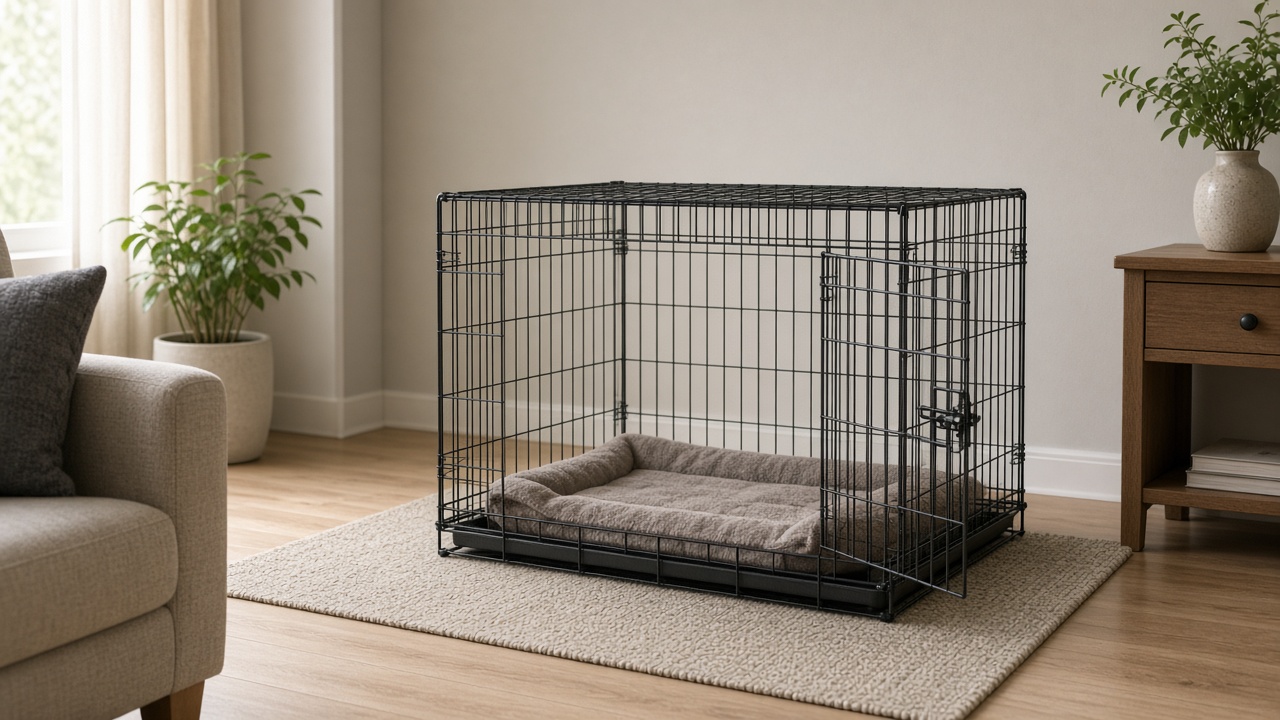
The right crate is a room the dog can use, not a box the dog is squeezed into. Size is the first decision. Everything else, the door, the pad, the place in the house, hangs on whether the dog can stand, turn, and lie down without folding up.
The fit
Cornell University's veterinary college describes the useful size this way: the dog can stand up without ducking, turn around, and lie down in comfort. Ohio State's Indoor Pet Initiative uses the same fit and adds one limit. The dog should be able to sit, stand, turn, and lie on a side, and should not have enough empty floor to toilet in one corner and sleep in another.
Those two ideas can seem to fight. They do not. A crate that is too small makes the dog unwilling to go in, because it is not a rest. A crate that is far too big teaches a puppy that one end is a bed and the other end is a bathroom. For a dog who is already reliable in the house, and whose crate is there to prevent chewing while you are out, Cornell says a larger crate with room to stretch is reasonable. For a puppy still learning where to go, keep the usable floor small enough that the bed and the toilet cannot be separate places.
A puppy who will be a large dog
Buy the crate for the adult, then shrink it for the puppy you have now. Cornell suggests a divider so the kennel can grow with the dog and you are not replacing it twice. Ohio State says the same thing in plainer words: if the puppy will be big, use the larger crate and block off most of it. Move the panel as the dog grows. Check the fit every few weeks. Ears and chest arrive before you expect them. When the dog's head ducks, or the turn looks cramped, give back a section of floor.
Picture the adult, not only the puppy in your lap. If you do not know how tall that adult will stand, ask the veterinarian or the rescue that knew the parents. A crate that is a little long is fine when a panel closes the extra. A crate the dog outgrows, head ducked and shoulders hunched, cannot be fixed with a panel. Recheck the three moves every few weeks: stand without ducking, turn without folding, lie down with the legs out. When one of them fails, open the panel or change the crate.
What the crate is for
A crate can keep a puppy from eliminating all over the house, give the dog a place to escape busy children, and stop chewing that could hurt the dog while you are gone. Ohio State also uses it to teach a calm alone time, which matters if you hope to prevent separation distress.
It is not a penalty. Alabama Extension says the crate should be a comfort, not a source of stress. Ohio State is direct about noise: do not punish a puppy for whining. If you open the door every time the puppy cries, the cry becomes the way out. Wait for a quiet moment, then open. If the puppy is not protesting but panicking, stop. Frantic digging, panting that does not settle, or a dog who gets worse instead of winding down needs a slower plan and, often, a veterinarian or a behavior professional.
Cornell draws the same line for adult dogs. A dog who is barking, pacing, panting, eliminating, or drooling from confinement should not be forced to stay shut in alone. Some of those dogs do better in a larger pen they cannot destroy, or with a person checking in. A crate that stops the sofa from being eaten, while the dog breaks teeth trying to chew through the door, has not solved the problem.
How long the door stays closed
A dog should not be shut in for a long stretch with no chance to relieve, play, and move. Ohio State says not to confine a puppy longer than that puppy can reasonably hold urine and stool. Overnight and a full workday are too long for a young puppy even when the training is going well. Accidents in the crate are often a timing problem, not a defiance problem. Let the puppy out more often.
At night, put the crate where you sleep if you can. You will hear the restless shift that means the puppy needs the door. Daytime practice starts with the door open, treats tossed in, meals fed inside, and the door closed only while the dog is busy and calm. End the session before the food is gone and before stress starts. Panting, yawning, and drooling during practice are signs to shorten the step, not to push through it.
Food, water, and an emergency
For ordinary training, the crate fits the body. For an emergency, Alabama Extension adds a practical requirement: the crate should also hold food and water, and still let the dog stand, turn, and lie down. If you live where storms or fire evacuations are part of the year, size that crate with the bowls in the picture, not only the dog. A pad that fills the whole floor and leaves no corner for a tip-proof bowl will not serve you on the night you actually leave.
A last look before you bring it home
Have the dog, or a honest measure of the dog, in mind. Stand-up room, a full turn, a stretched lie-down. A panel if the dog is still growing. A door that latches. A spot in the room where the family actually sits, not a closed basement. And a rule you keep: the crate is a place the dog rests, and the door opens before the dog is desperate.